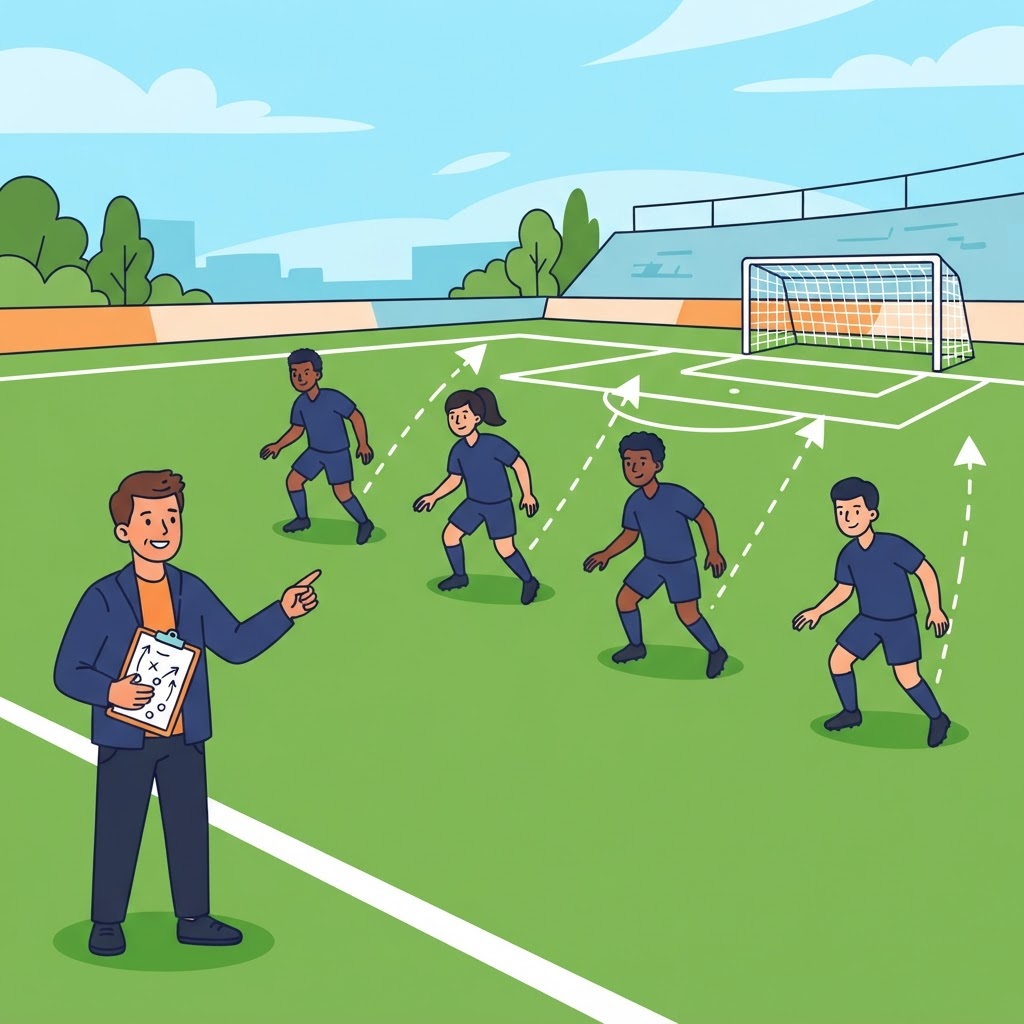
Coaching the Back Four: A Four-Week Progression from Technique to Game
A four-week progression for coaching the back four: shape without opposition, defending 4v3, adding the full picture, and finishing in game context. One habit at a time.
Every grassroots coach has had the same thought in the middle of a match: "the back four keeps getting pulled apart."
The instinct is to fix it in one session — a heroic evening of defensive shape work. It never sticks. Defending as a unit is a chain of habits: spacing, body shape, who presses, who covers, when the line drops. Habits need weeks, not one Tuesday.
So here's a four-week progression for coaching the back four — one that moves from simple to game-realistic without skipping steps.
Week 1: Shape without opposition
Before players can defend together under pressure, they need to understand the picture: where does the line sit, and how does it move as the ball moves?
- Practice: Back four on a half-pitch, no opponents. Ball (or a coach walking with the ball) moves between zones on the pitch ahead of them — the line shifts across, narrows and expands, drops and steps up together.
- Coaching points: Distances between defenders stay roughly the same — the line moves as one. Open body shape to see ball and pitch. The widest defender anchors the line; nobody steps out alone.
- Success looks like: The line moves smoothly in sync without anyone calling for instructions.
Week 2: Four versus three — defending the line
Add opposition, but tilt the numbers so the back four can succeed. Three attackers move the ball in front of the back four, trying to play through or around.
- Practice: 4v3 in a central zone. The attackers get a point for a completed pass through the line; the defenders earn points for regaining and playing out.
- Coaching points: Who presses (nearest defender), who drops and covers (the rest of the line). The line doesn't get dragged — it slides. When the ball goes backwards, the line steps up together.
- Success looks like: Defenders communicate before the pass arrives, not after.
Week 3: Add the full picture
Now make it hard: equal numbers, wide players, a realistic attack.
- Practice: 7v7 on two-thirds of a pitch. One team attacks with a back four defensive unit — wings included. Focus on the line's reaction to the ball switching sides, forward runs, and balls over the top.
- Coaching points: Screen the pass into the striker. Decide as a line: drop or step? Handle the ball in behind — who shows, who recovers? The goalkeeper joins the line as the fifth defender.
- Success looks like: The back four makes the same decision at the same moment.
Week 4: Game context
Finish in a game where the theme lives — conditioned so the defenders get tested constantly but still have to play real football.
- Practice: Full-size game with a condition: any restart, the attacking team must play forward within five seconds (forcing the back four to manage balls into the striker and in behind). Award bonus points for a clean defensive half.
- Coaching points: Coach in the game, not in the drill. Freeze only to fix repeated errors — spacing, stepping up after clearances, rest defence when attacking.
- Success looks like: The habits from weeks 1–3 appear without prompting.
The mistake to avoid
Skipping ahead. If the line can't shift together in Week 1, adding opposition in Week 2 just teaches panic. Every week's success is the licence to move to the next. When in doubt, repeat a week — players don't get bored of getting better.
Structure each week's session with the same skeleton — arrival activity, main practice, game context — and your progression does the teaching.
Football Club Hub's session builder and drill library make it easy to plan, store and repeat progressions like this one. Free to start.
Less admin. More football.